AI Automation for Marketing Ops
AI is widespread in marketing—yet most teams still misuse it as a 'shortcut to insights.' In 2026, high-performance marketing operations use AI to automate execution, not replace judgment.

AI is widespread in marketing—yet most teams still misuse it as a "shortcut to insights." That's backward.
In 2026, high-performance marketing operations use AI to automate execution, enforce data quality, and power workflow orchestration across analytics, reporting, and revenue systems. AI should augment human decision-making, not replace it.
This article provides a practical, engineering-oriented playbook that centers on tools like Funnel.io to orchestrate data pipelines, automate validation, and support AI-assisted workflows.
1. Where AI Should Actually Be Used in Marketing Ops
Let's unpack where AI adds real value—and where it doesn't.
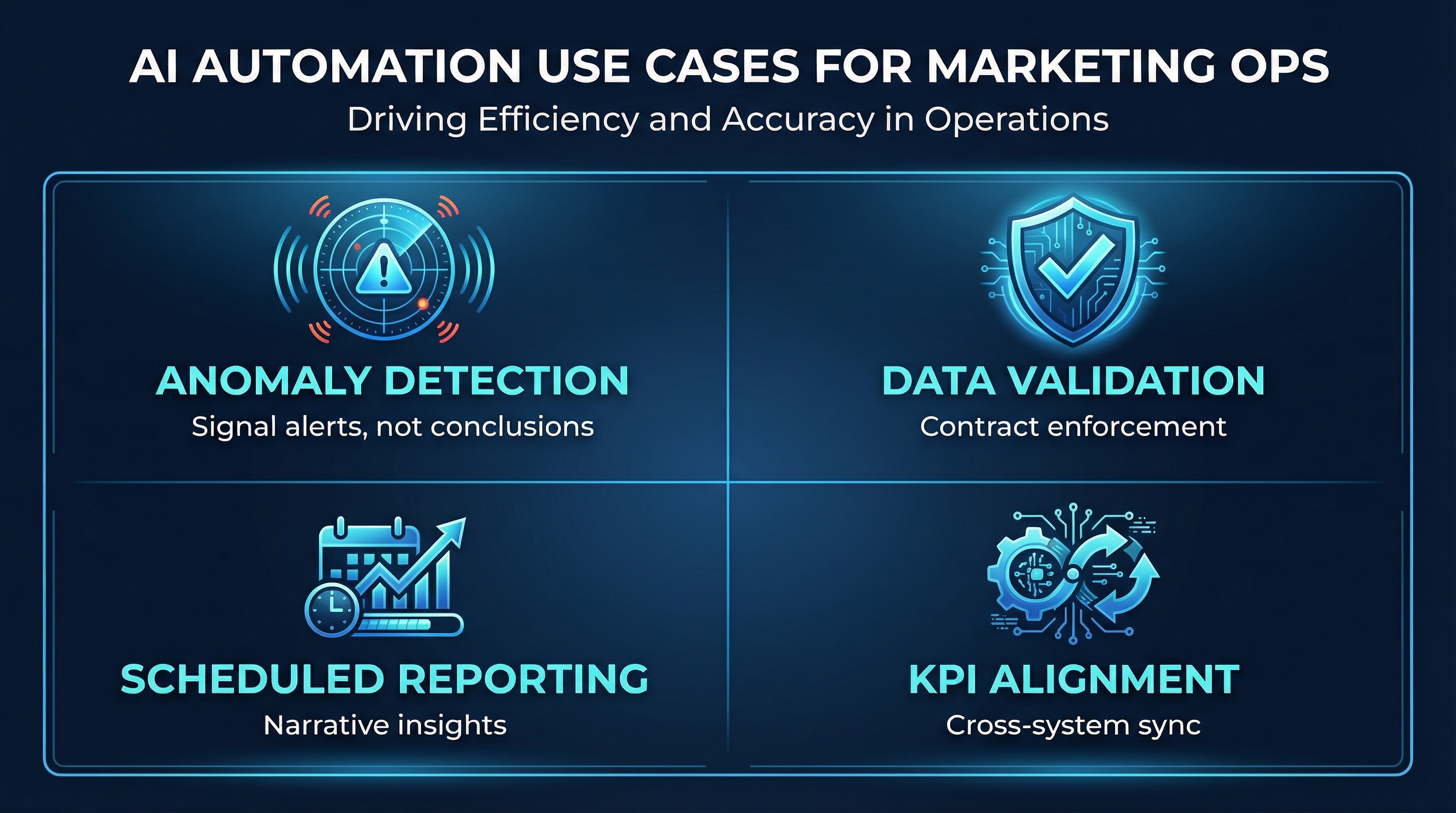
❌ Where AI Should NOT Make Decisions
- • Defining core KPIs
- • Business strategy conclusions
- • Attribution model selection
- • Budget allocation decisions
These require context, incentives, and accountability—things AI does not possess.
✅ Where AI Does Add Value
- • Detecting deviations or anomalies
- • Generating summaries and patterns
- • Augmenting repetitive operational work
- • Enhancing cross-system monitoring
This is automation, not judgment.
2. Funnel.io: The Automation Backbone
Funnel.io is not an AI model—it's a data integration and orchestration platform that centralizes marketing data from dozens of sources (ads, analytics, CRM, commerce) into unified exports.
Think of Funnel as:
- 📥 The central collector — aggregates data from all marketing platforms
- 🔄 The data normalization engine — standardizes schemas across sources
- 🤖 The foundation for AI-assisted monitoring — clean data enables reliable automation
AI tools plug into clean, consistent data outputs—not into messy raw sources. This pattern is foundational if you want reliable automation.
3. Core Automation Use Cases Powered by Funnel.io + AI
Here are automation patterns that scale without adding risk:
Use Case 1 — Automated Anomaly Detection
Problem: Key metrics shift without warning.
Pipeline:
- Funnel.io pulls daily metrics from Ads (Meta, Google, LinkedIn, TikTok), Analytics (GA4), CRM/Sales
- Export to BigQuery or BI
- AI or statistical model detects meaningful deviation
- Alert triggers with context
Result: Faster detection, fewer false alarms, alerts you act on. AI detects change, humans interpret why.
Use Case 2 — Data Validation & Contract Enforcement
Problem: Tracking or tracking logic breaks silently.
Pipeline:
- Funnel.io normalizes metrics and dimensions
- Export to BigQuery
- Automated checks: Missing fields, value spikes/drops, schema drift
- AI highlights divergences
- Alerts or tickets are created
Outcome: Trustworthy pipelines, early warnings, root causes surfaced faster. AI supports validation, not edits.
Use Case 3 — Scheduled Reporting with Narrative
Problem: Manual report building wastes cycles.
Pipeline:
- Funnel.io exports normalized dataset
- Scheduled query + transformation
- AI generates narrative insights (e.g., "CPL increased week-over-week by 12%")
- Delivery via email, Slack, or dashboards
Outcome: Consistent reporting, automated summaries, narrative + data. AI adds pattern recognition and plain-language text.
Use Case 4 — Cross-System KPI Alignment
Problem: Data doesn't match: CRM vs Analytics, Ads vs BI, Commerce vs Product.
Pipeline:
- Funnel.io unifies data schema
- Export to central warehouse
- AI identifies inconsistencies
- Alerts/Bots notify owners
Outcome: One version of the truth, fewer reconciliation meetings, more confidence in dashboards. AI does pattern detection; humans fix sources.
4. AI Guardrails: Execution, Not Mutation
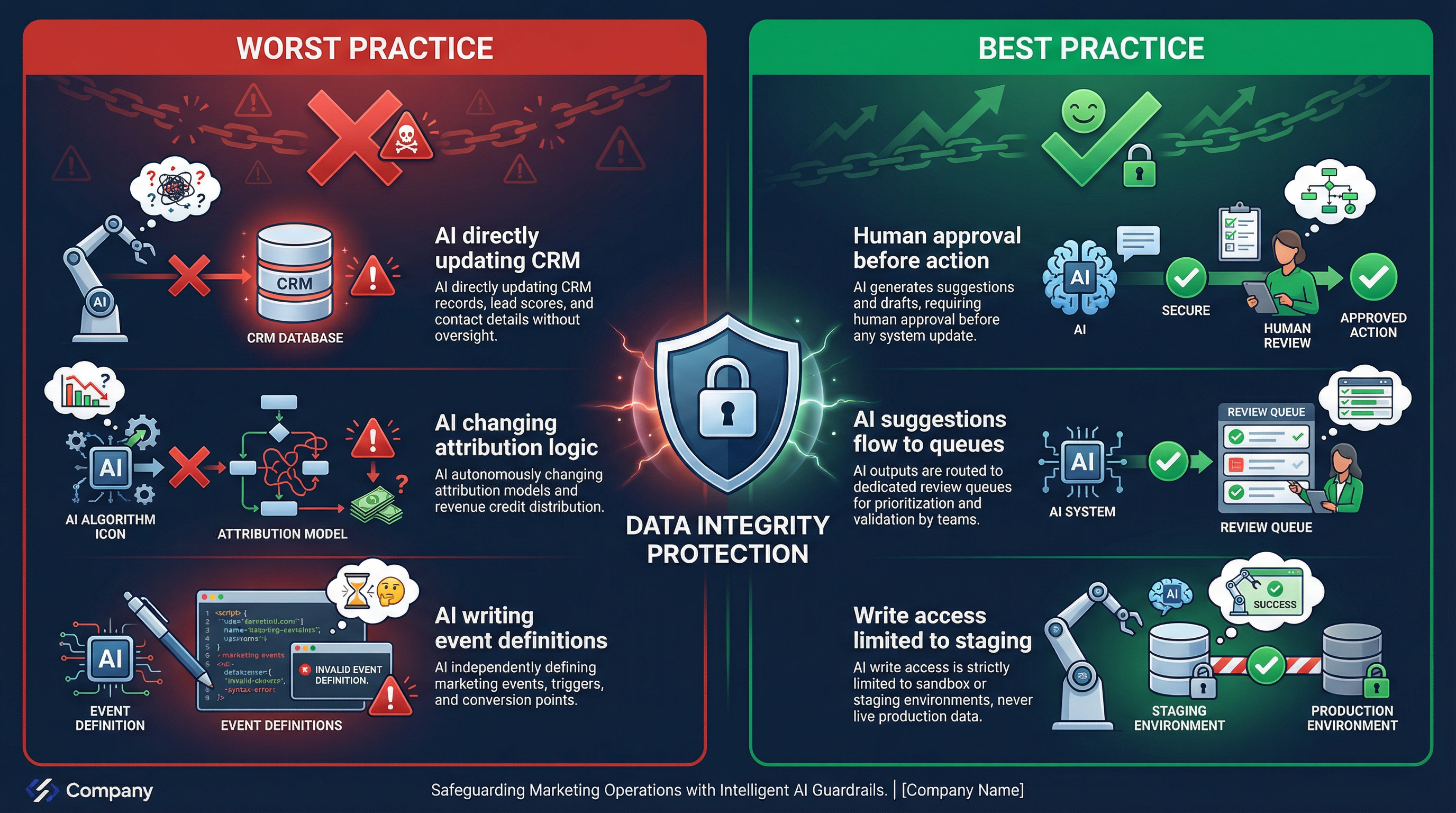
A core principle: AI may flag, classify, summarize, or recommend—but should not directly mutate source systems.
Worst Practice
- ❌ AI directly updates CRM fields
- ❌ AI changes attribution logic
- ❌ AI writes GA4 event definitions
Best Practice
- ✓ Human approval before action
- ✓ AI suggestions flow into queues (Jira, Slack)
- ✓ Write access limited to staging/testing
This protects data integrity.
5. A Scalable Automation Architecture
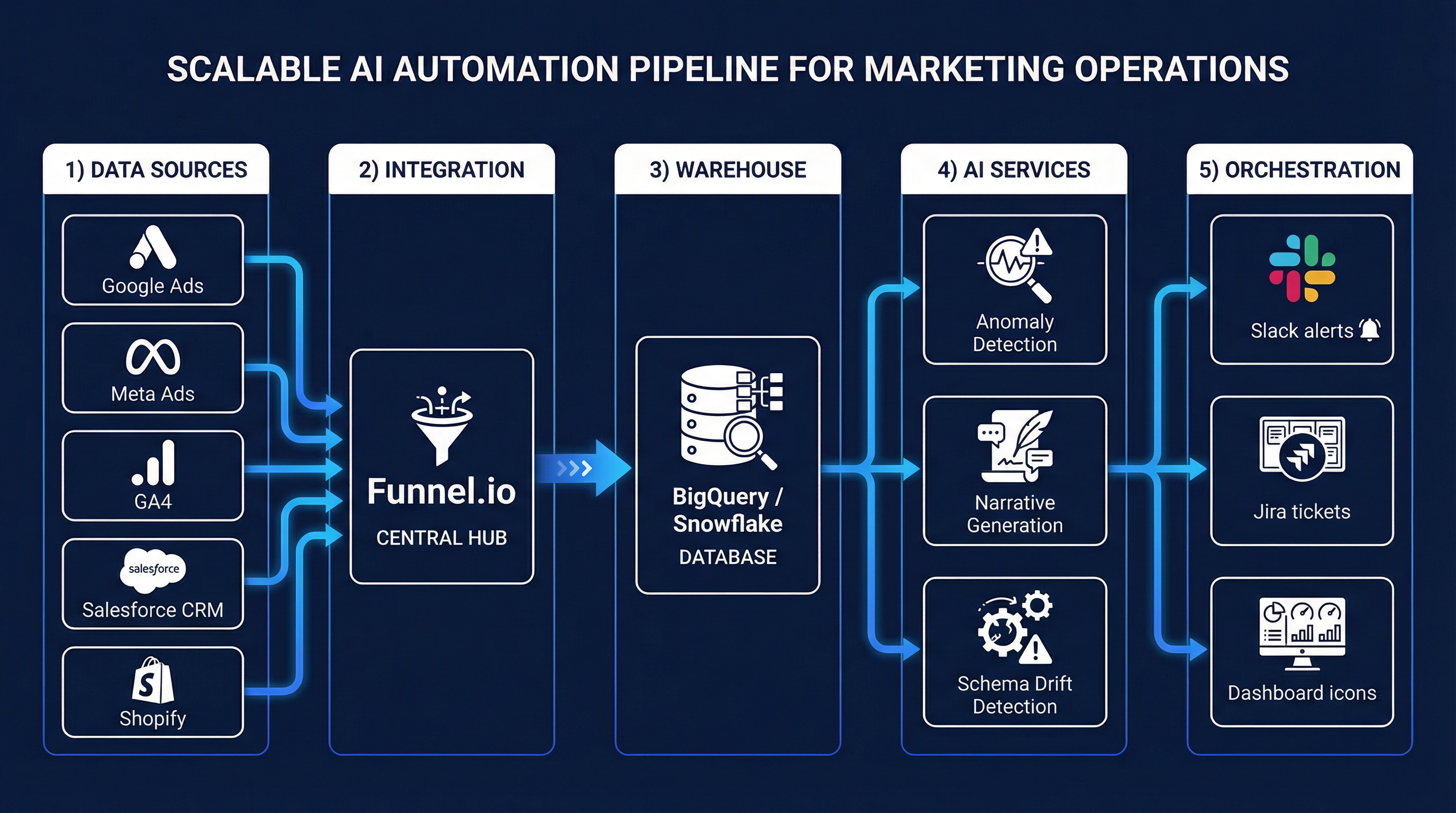
Common Pipeline Architecture:
- Data Sources: Ads, analytics, CRM, commerce, email
- Integration: Funnel.io normalization / collection
- Warehouse: BigQuery or Snowflake
- AI Services: Anomaly detection, Narrative generation, Schema drift detection
- Orchestration: Alerts, tickets, dashboards
Funnel.io is the central hub feeding clean data into all downstream processes.
6. Governance: The Difference Between Automation and Chaos
Automation amplifies quality only if systems are engineered well.
Minimum Governance Layers:
- 👤 Ownership per data source
- 📝 Change logs and versioning
- ⚙️ Defined thresholds for automation
- 🛑 Kill switches & rollback plans
Without governance, automation magnifies mistakes—not value.
7. Quantifying Automation Success
Success is NOT:
- • Number of automated workflows
- • Volume of AI calls
- • Fancy dashboards
Success IS:
- ✓ Fewer manual checks
- ✓ Faster time to detection
- ✓ Stable KPI delivery
- ✓ Reduced tactical work
If trust rises, automation is working.
8. Common Engineering Mistakes with AI
- ❌ Letting AI define metrics — Metrics require business context
- ❌ Treating AI as oracle — AI is a tool, not a decision-maker
- ❌ Automating before stabilizing data — Garbage in, garbage out
- ❌ Ignoring alert fatigue — Too many alerts = no alerts
Automation without quality is auto-propagated noise.
Closing: Automation is About Reliable Execution
The future of Marketing Ops isn't "AI decides everything."
It is engineered systems, clean pipelines, and reliable execution with AI assisting repeatable patterns.
Tools like Funnel.io create the foundation, and AI helps by augmenting detection, summarization, and operational coordination—not by replacing human interpretation.